Collection
The enforcement team's evidence engine.
IT Security defines what to protect. Legal defines what to preserve. When a violation occurs, the enforcement team needs forensic-grade evidence from every source — fast, defensible, and with unbroken chain of custody.
The Enforcement Gap
What IT Security & Legal defines
Data retention policies, legal hold obligations, acceptable use rules.
Where enforcement breaks down
When the enforcement team needs evidence, it's scattered across 5 tools. Collection is manual, slow, and the chain of custody has gaps that get challenged in court.
What the enforcement team handles
A ransomware incident hits Finance. The enforcement team needs endpoint images, email logs, and cloud data from three providers — collected simultaneously with forensic integrity.
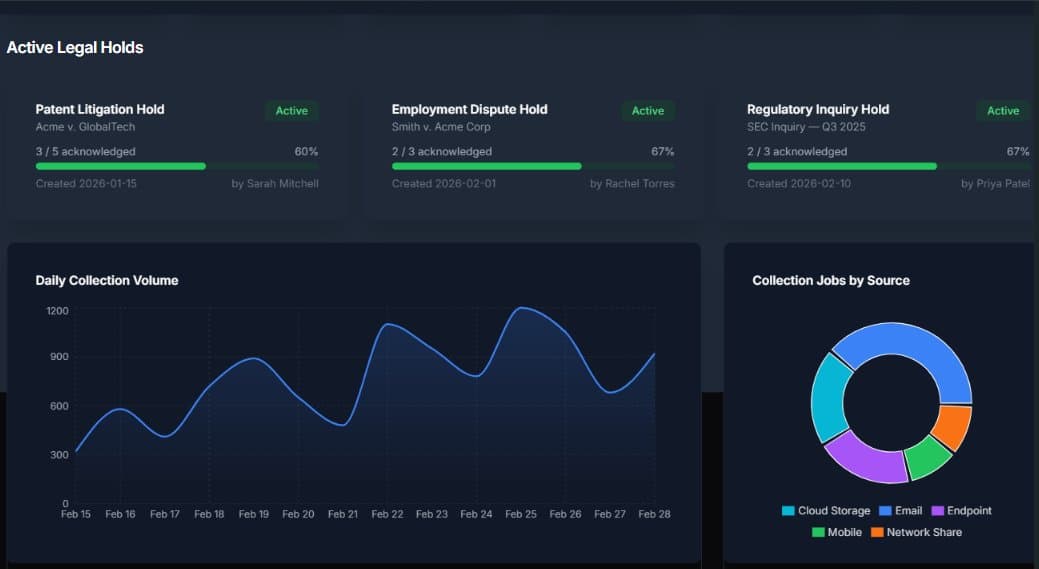
Legal issues a preservation notice. 47 custodians across 3 countries. The enforcement team needs to place holds and begin collection without disrupting business operations.
A whistleblower reports procurement fraud. The enforcement team needs to silently collect mobile messages, email, and cloud storage from specific custodians before evidence is destroyed.
How It Works
Scope
Define custodians, data sources, and collection parameters. Place legal holds.
Acquire
Forensic acquisition from all source types in parallel. SHA-256 hashes computed at source.
Process
20+ AI stages — deduplication, OCR, entity extraction, classification, language detection.
Deliver
Processed evidence available in Investigation, Review, and Intelligence modules automatically.
Part of the enforcement platform
Collection doesn't work in isolation. Here's how it connects.
Investigation
Collected evidence feeds directly into the case record
Review
Processed documents are ready for review without export
Intelligence
Extracted entities populate the intelligence graph
Why OrcheSight
Your IT team can image a drive. Your legal team can issue a hold. But neither can run a forensic collection across 5 source types simultaneously while maintaining chain of custody. That's what the enforcement team does — and Collection is their engine.