Interview Room
The enforcement team's interview methodology — powered by AI.
HR conducts interviews. Legal takes depositions. Fraud teams interrogate suspects. But none of them have a structured methodology with AI-powered analysis. The enforcement team does.
The Enforcement Gap
What HR, Legal, Fraud defines
Interview protocols, witness handling procedures, documentation requirements.
Where enforcement breaks down
An HR manager interviews a misconduct suspect, takes handwritten notes, and files them in a folder. Three months later the case turns on what was said in that room, and all that survives is a page of notes and a memory.
What the enforcement team handles
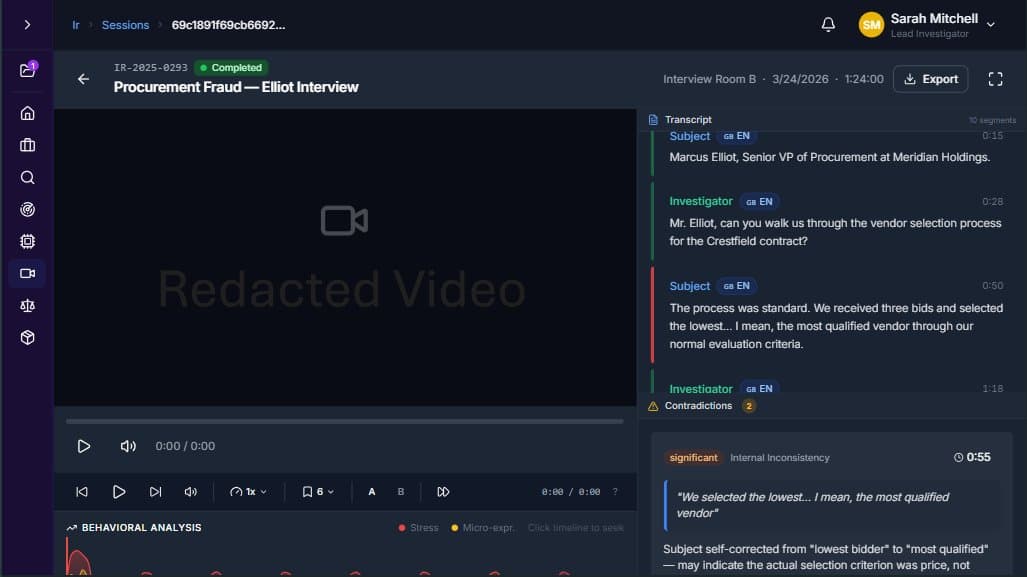
A procurement fraud interview runs for two hours across three speakers. It is transcribed as it happens, attributed per speaker, and every answer carries a timestamp an investigator can return to.
The enforcement team conducts 12 interviews across a workplace investigation. Every session is transcribed and searchable in the case record, so what a witness said in March can be read against what they say in June.
A regulatory interview is recorded, transcribed and analysed automatically. The team produces an interview report with timestamps and behavioural annotations, attached to the case record.
How It Works
Prepare
Set up session with case context, prior statements, and methodology template.
Conduct
Speech is transcribed as it happens, attributed per speaker, with behavioural signals tracked alongside.
Analyse
A summary with key findings, a timeline of the session, and action items.
Integrate
Findings link to the case record. Transcripts are searchable across the investigation.
Part of the enforcement platform
Interview Room doesn't work in isolation. Here's how it connects.
Investigation
Interview findings and transcripts link directly to the case record
Intelligence
Entities mentioned in interviews populate the intelligence graph
Review
Interview transcripts are searchable and reviewable alongside documents
Why OrcheSight
Most interviews survive as handwritten notes and a memory of the room. The Interview Room keeps the recording, a speaker-attributed transcript, and the behavioural signals worth a second look — built on what forensic practitioners have refined over 25 years, with the record kept instead of remembered.